The Empty Space on the Menu: Reading a Country Inn Kitchen by What It Leaves Out
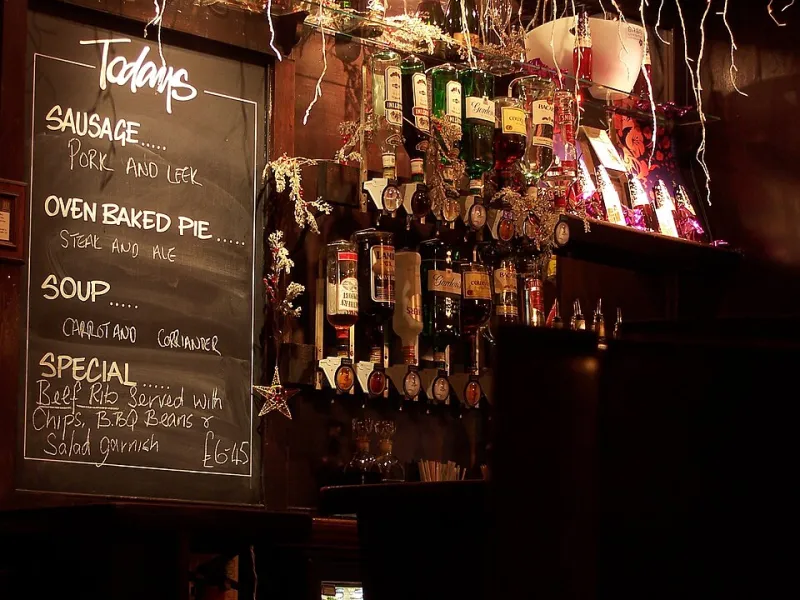
Photo: Ollecram1974 at Italian Wikipedia, Public domain, via Wikimedia Commons
Menus are persuasive documents. They are written to make you hungry, to steer you towards the profitable dish, to reassure you that there is something for everyone. That is fine. But the most interesting part of a country inn menu is often the space between the lines: the dish that is not there.
A missing local cheese. A fish option that has vanished by Tuesday. A suspiciously long list of crowd-pleasers that could all come from the same freezer. These gaps are not failures. They are clues. If you learn to read them, you can tell a lot about a kitchen before you order.
The Tyranny of the Crowd-Pleaser
A menu with forty dishes is not automatically bad. But it is worth asking how a small kitchen keeps all those ingredients fresh. Burgers, lasagne, fish and chips, curry, pie, risotto, noodles: that is a lot of different shopping. Some of it will be frozen. Some of it will be bought in. That is not a crime, but it is a choice.
A shorter menu is often a more honest one. It says: this is what we can do well today. It also says: we would rather waste less and cook better. The gap where the lasagne used to be might be the most truthful thing on the page.
The Missing Local Cheese
If you are in a dairy county and there is no local cheese on the menu, ask why. It might be a supply issue. It might be that the kitchen has not bothered. It might be that the cheese board is all imported and the kitchen is hoping you will not notice. A good cheese board names the farms. It might be three cheeses, not twelve. It might change with the season.
The absence of any cheese at all is more telling. A country inn without a cheese board is like a bookshop without poetry. It can happen, but it raises a question.
Out-of-Season Fish and the Honest Gap
Fish is a good test. A landlocked inn offering a long list of fish dishes on a Monday is either very well organised or very good at buying frozen. A menu that says 'no fish today' is more reassuring. It means someone is buying fresh, and fresh fish does not always arrive.
Ask what is good today. The answer will tell you whether the kitchen is cooking from its supply or from its freezer. If the server says 'the fish is off, but the pork is from a farm three miles away and it is excellent', that is a kitchen you can trust. The gap has become a recommendation.
What a Short Menu Is Saying
A short menu can be a sign of confidence. It can also be a sign of a tired kitchen with no ideas. The difference is in the detail. Are there vegetables that change with the season? Is there a dish that sounds slightly odd but specific, like 'beetroot and horseradish tart'? Does the menu mention the farm, the baker, the smokehouse?
If the short menu is all burgers and chips, it is not a statement of confidence. It is a limitation. If it is four starters, four mains and a couple of puddings, each with a named supplier or a seasonal note, it is a kitchen that knows what it is doing.
Three Polite Questions to Ask When Booking
You do not need to interrogate anyone. But a few polite questions can tell you a lot. First: 'What has been particularly good this week?' Second: 'Is there anything you are out of, or waiting on?' Third: 'Do you change the menu daily?' These are not hostile. They are the questions of someone who cares.
The answers are revealing. A kitchen that says 'we sold out of the lamb, but the beef is great' is a kitchen that cooks fresh. A kitchen that says 'everything is available' with a forty-item menu is telling you something else. A kitchen that says 'the menu changes every day and we will not know until the morning' is probably worth booking.
The Confidence of the Incomplete
The best country inns are not afraid of gaps. They know that a menu is not a contract to provide every dish ever invented. It is a snapshot of what is good right now. The missing local cheese, the absent fish, the short list of puddings: these are not holes. They are evidence.
So when you book, read the menu for what it leaves out. Then ask a polite question. The answer will tell you whether the kitchen is honest. And an honest kitchen is usually a kitchen worth eating in.